Where We Will Go

.

For the last 18 months I have been making a film, Where We Will Go, with parents who have experienced neonatal baby loss, in partnership with Newcastle University, the Neonatal Intensive Care Unit at the RVI in Newcastle and with the charity Tiny Lives. I have been able to apply the processes and research that I have been developing in the studio for ‘To Be Two’ and reflecting upon in this blog.

For the making of Where We Will Go, it was clear to me that the intense and deeply emotional nature of the parent’s experiences required a methodology that would create space for them to talk around. In one of our very early meetings, one of the parents said to me he didn’t want the film to be something he couldn’t bring himself to watch. Another parent expressed a desire to make it for her son – the twin of the baby who had died. These assertions were both really useful objectives to begin the project. I wanted to make something that addressed the subject of the loss of a child, but was celebratory, and a sort of keepsake as well as being an honest insight of their experiences that might help other parents experiencing similar things.

I invited the parents to walk with their children somewhere they went when they wanted to think, or talk about the child who had passed away. I asked them to follow a sensory path through this walk, collecting things they found on the way –sticks plants household detritus and found objects as well as snippets of conversation, drawings in sketch books and any resonant thoughts and memories. 

These materials were infused here in my studio and made into inks stains papers – a sort of pre-lingual toolkit we could use to ‘speak through’. In our meetings at the university, we used these inks to write and draw – a way of creating new contexts for painful pasts. 

Using transcripts made of our conversations in the workshops, as well as the sketchbooks the parents wrote and drew in, I wrote a script for the film and together we each recorded parts of it. It was a pretty magical experience. The parents were so invested in the making of these inks and their significance regardless of whether the materials produced the deep blue and purple inks of bilberries, or clear ‘silence’ of distilled dandelion clock seeds.

.

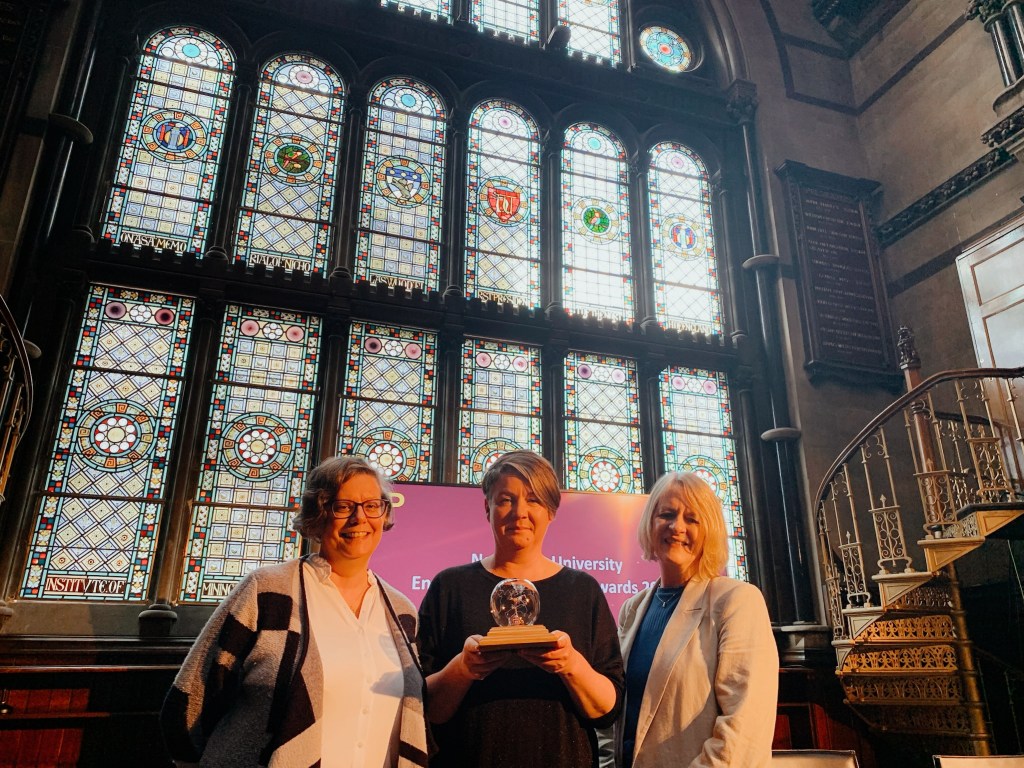
In May 2023, Where We Will Go, was awarded a Newcastle University Engagement and Place Award
.

screenings:

‘Communities and Change’ exhibition, Newcastle Contemporary Art, July ’23
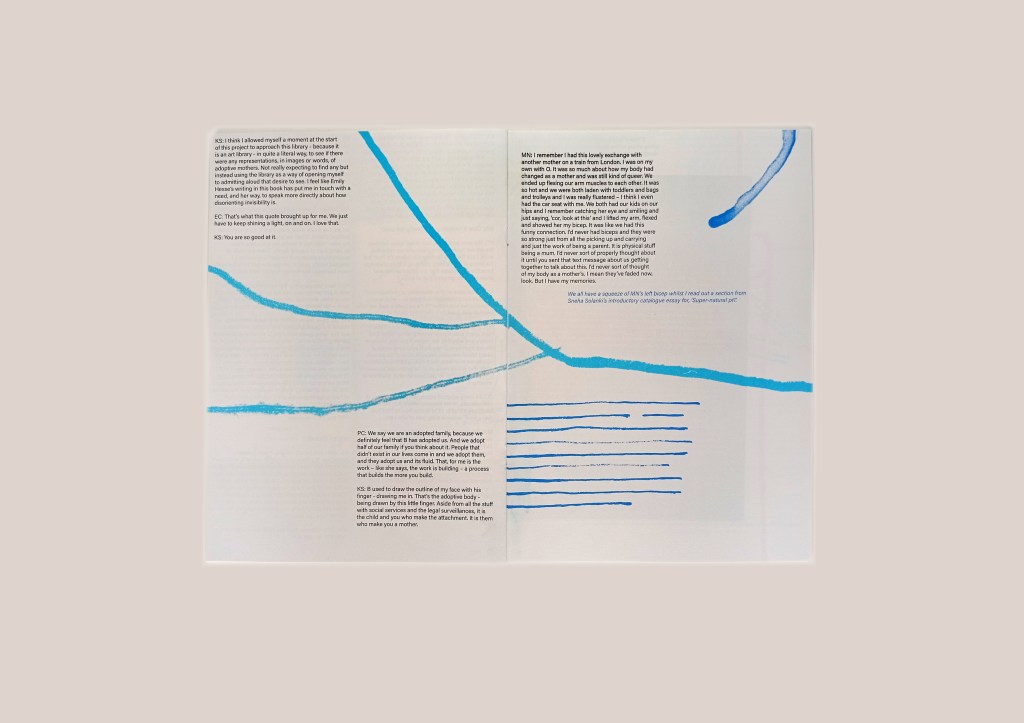
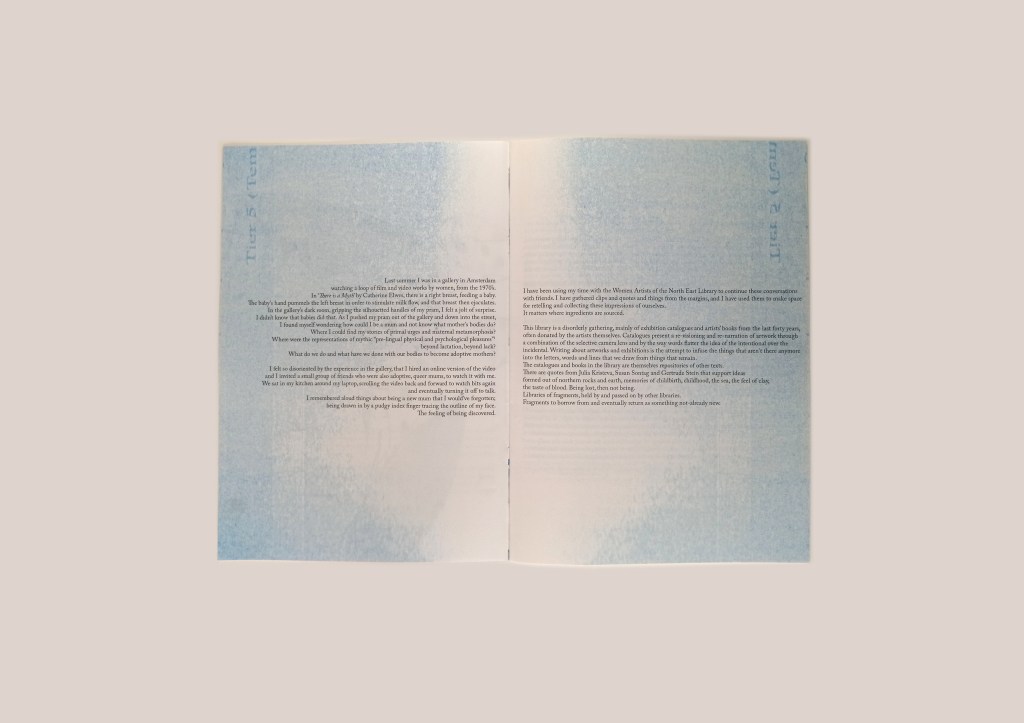
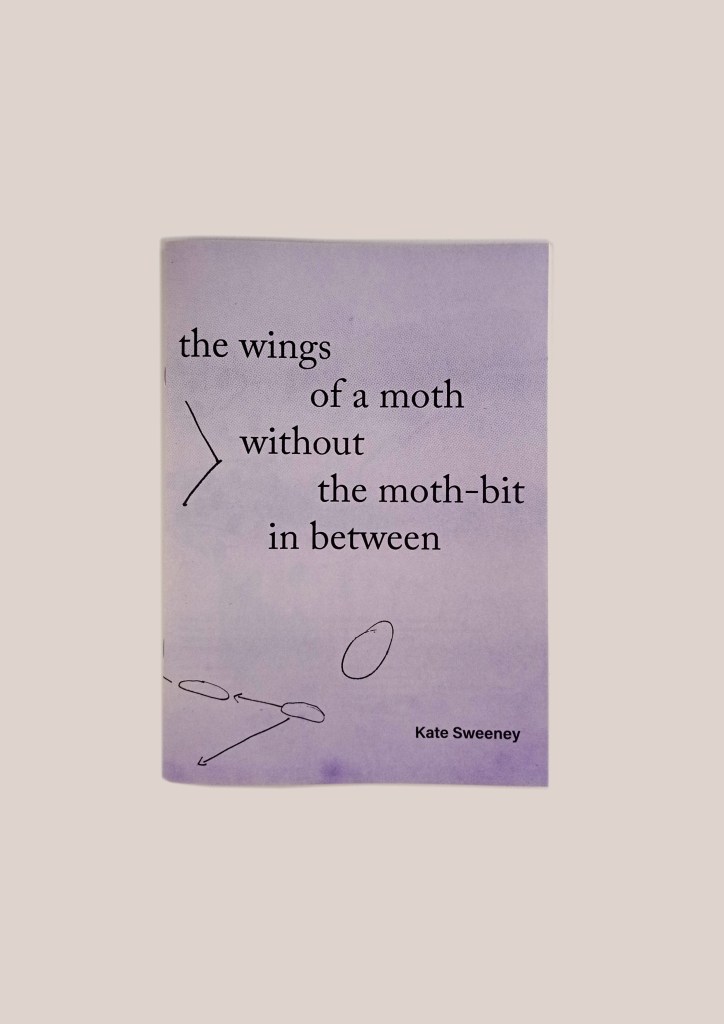
the wings of a moth without the moth-bit in between

By Kate Sweeney (2023, Threed)

Produced by

the Women Artists of the North East Library

Printed by Foundation Press

A4 riso-printed artist book

Softcover 34pp

   ‘Sometimes my baby’s head smells of old libraries.

   Lignin. Weighted paper, ink, dry glue.’

the wings of a moth without the moth-bit in between (2023) documents artist Kate Sweeney’s search for traces of the adoptive mother’s body in the WANE Library. Kate Sweeney’s new writing combines lyrical memoir and citations from artists and authors in the library, alongside transcripts of conversations to share a queer experience of parenthood. 

the wings of a moth without the moth-bit in between is a multi-faceted exploration of the function of and conditions for the collective acts of borrowing and lending. In drawing parallels between building and maintaining a queer family and a library, it contributes to contemporary discourses surrounding artist’s practice in archive and library-based contexts. 

Kate Sweeney was commissioned in 2022 through the WANE Library’s first Writing Commission, and was collaboratively designed, then printed by Foundation Press. The commission was funded by Arts Council England.

To Be Two

.

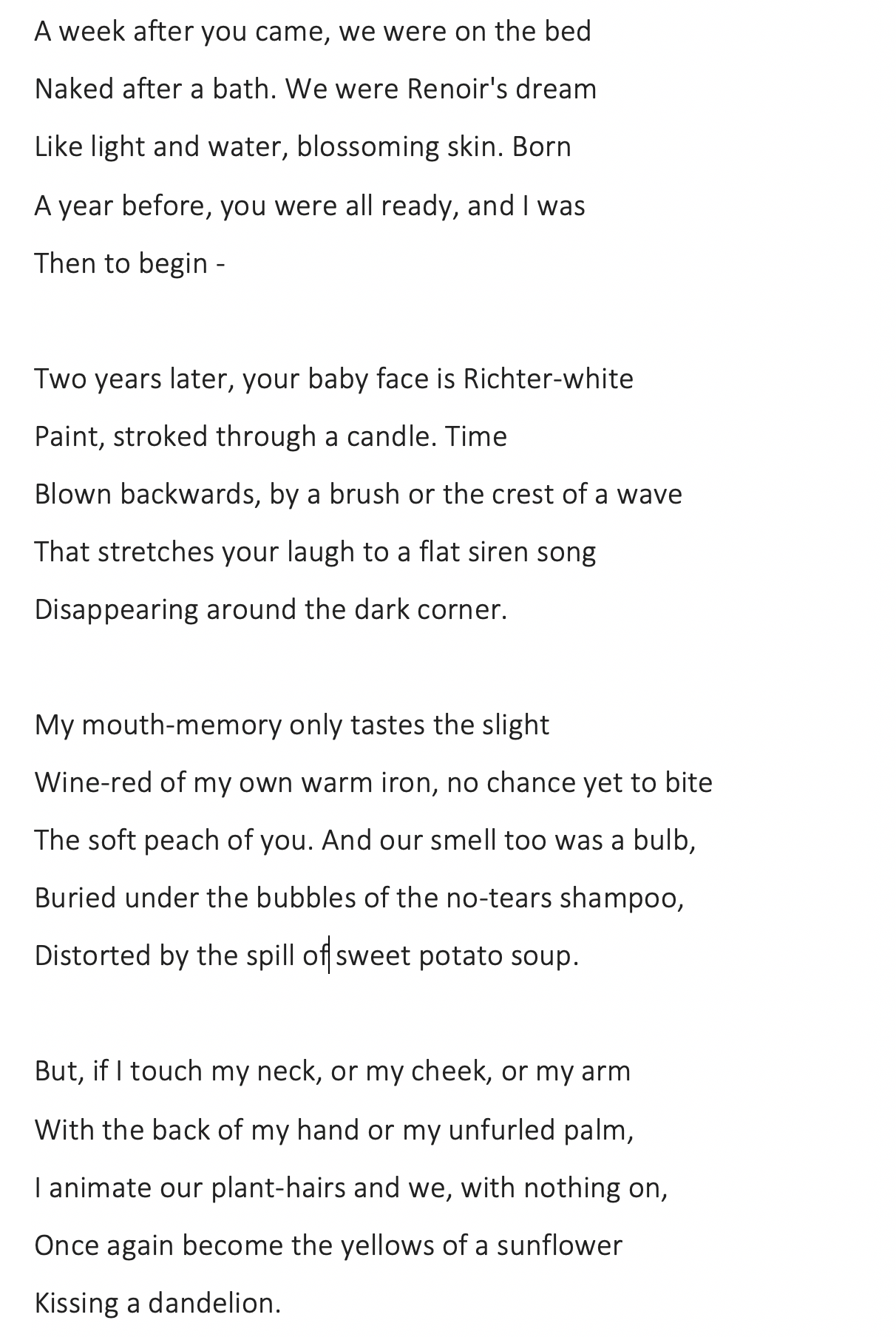
To Be Two is painted using my own inks, dyes and stains, made out of the materials gathered and adapted from my immediate and intimate surroundings such as plants, mud and household detritus things within my arm’s reach. The piece brings together moments and the materials from the everyday to focus upon the way emotions, feelings and bonds that originate within and between bodies are transferred and shared. It is a collage of animation, video, poetry and sound recordings. To Be Two seeks to create a new myth of motherhood. Water and colour – instead of blood or DNA – become the metaphor and material for describing how we imagine and manifest our selves through each other. It is an origin story of becoming – mothers, a son, a family.

.

.

.

.

.

.

.

.

.

.

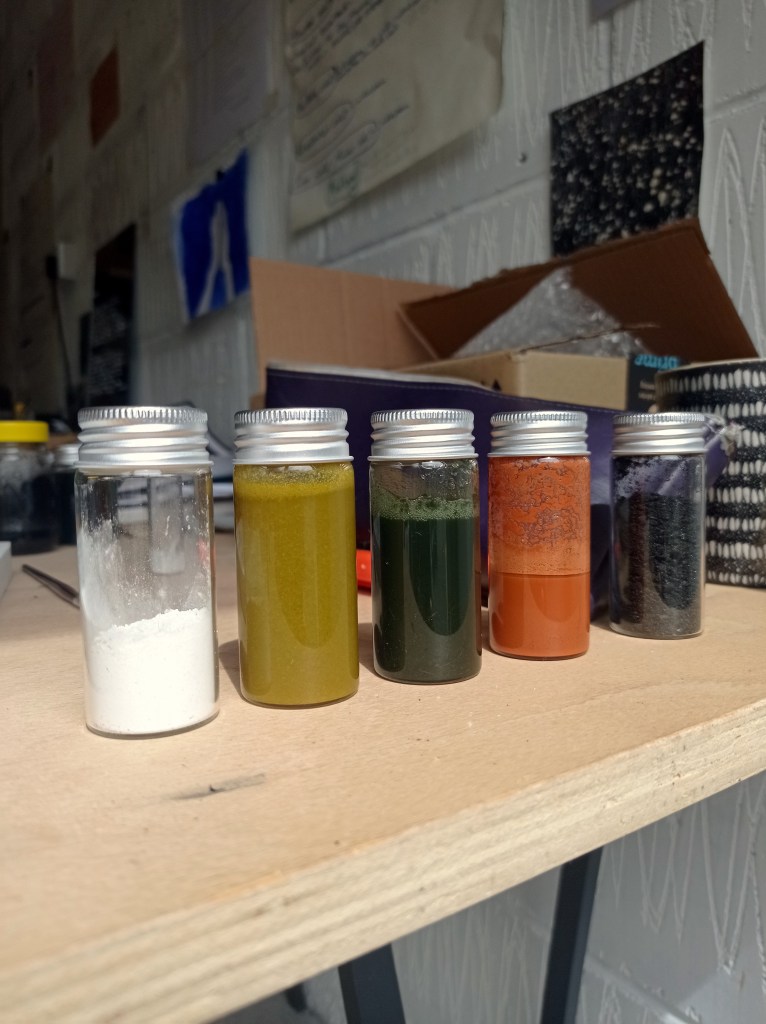
inks

#plasterandhairwhite

#lastdandelionsyellow

#thegardengrassgreen

#brickdust

#deepcharcoalblack

.

Sometimes, space between

these two things, places, people,

is more than their selves

.

The brownfield land behind the house a couple of weeks ago as I walked through to the river. The animation in it was painted using the inks and dyes I made from materials above, mentioned in the video.

.

.

.

.

.

.

keen

I had been wondering to myself if it was acceptable to boil seeds. Beginnings should not be cut short I thought, standing and brewing whole heads of dandelion clock on the stove. But 

who says where the beginning is? 

Things fall into other things –

Get over one self to become 

An other self. Desire,

Pulling down over and over,

Crowns into earth and off again. 

Making inks and dyes from nature in any stage of their cycle Living involves making many interceptions. By picking up and moving things out of their biomes, out of (their) place we cause disruption. We are also disturbed and reformed, by rain and soil, webs, viruses and 

scattered clouds of concealed colours.

It is only from just under six foot

Above the surface of the ‘scene

That death arrives alone as night 

And the sign for life is sunlit green. 

Get down.

On my hands and knees, rabbit-height, 

Rat-eyed, everything is toddler. Between 

The weighted ground and a blanket of stars

Reality is churning, bright, unseen. 

HairBrush

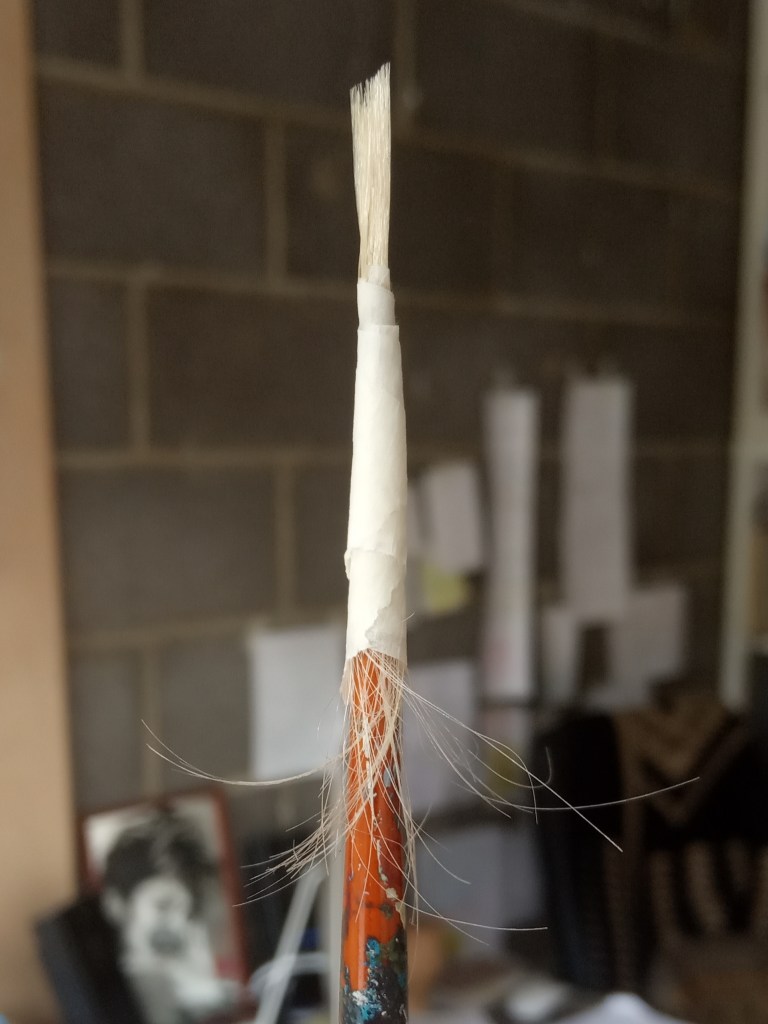
Last week I screened my short film, ‘Little Light‘, that documents the making of a paintbrush from my son’s hair (and then using the brush to paint each frame of the film). It was to a small audience at our wonderful, local volunteer Star and Shadow cinema. It was made in lockdown a year ago and has only been screened in installation form, or at remote, online festivals. So this was the first time I’d seen it on a big screen, and I was really struck by the film’s beauty, but also the obscure nature of its narrative. I was relieved that, in my introduction, I had decided to read aloud a poetic text that sits in parallel to the piece. It is not a description of it, but rather a reflection upon a moment. Minutes before I stood in front of the crowd, I changed line and I added a word, ‘sink’. By giving the world of the piece a location, I felt I had let a little light through.

After the screening I reflected upon my decision to read the text and felt excited by this urge to let people in. When working in collaboration with poets, I have always felt it important to sit back, and let the writer take responsibility for the narrated ‘invite’ to the audience. Artist Tom Konvyes describes a video poem as a ‘juxtaposition of image, text and sound’, and I have allowed my visual contribution to be a personal playground of visual ideas that runs in parallel to the text that allows for moments of alignment or poetic coincidence. It had started to feel like an increasingly guarded, distant way to work. ‘To Be Two‘ is my own. It is a careful exploration of how to preserve as well as discuss the private, the intimate and the stories that belong to other people. This tension, between sharing and protecting, is key to being a mum, as well as an artist. I decided I wanted this text to become a part of the film. 

The new iteration of ‘Little Light ‘ is called, ‘HairBrush‘. Writing and then performing the text as well as drawing my new work means I am having to challenge myself to consolidate. A collaborative piece, for me, is a sum of parts. I now want to resolve those parts into something more definitive and singular. Adding my voice to my work feels like edging around an unknown corner following an unfamiliar sound, like a walk in the dark with a toddler who has just begun to understand the possibility of wolves, and the majesty of the moon.

HairBrush‘ is a meditative reflection upon an everyday activity – a haircut. It documents the laboured process of making a paintbrush out of a golden curl from my son’s head. The brush then being used to paint each frame of the film. Watercolour, instead of blood or DNA, becomes the metaphor and material for describing how we imagine and manifest our selves through each other.

.

.

.

.

.

water

 ‘It matters what matters we use to think other matters with’… ‘It matters what relations relate relations’…*

A relation is a connection. It is a channel along which a story can be communicated (related) in order to connect to an other’s story, another relation. 

Blood is the way it has always been. A tongue in the dark, something thick. Blood is the unseen duty that is destiny and faith. The inside warm is outside cold when pricked. Blood is reason for everything unreasonable.

DNA is now what will be will be. The code in lights. The key, or history in a perfected pattern of unquestionable proof. A lab coat has replaced the cloak with the idea of the truth. There is the cell we can all be freed from by spitting an image in a bottle of answers for everything.

And yet

The way rain falls, or tears dance says something is coming in our water, we are always wet. Relentlessly contingent, our body expands beyond skin and time as a river reaching, never set.

.

* Donna Harraway. ‘Staying With the Trouble’. p12, p35

.

.

beginning with a name

On a Hill‘, is from our walk down to the Tyne in early June. Blackberry and cotoneaster-dyed paper, animated with drying Tyne water and sycamore, is cut with birds taking advantage of early summer thermals. For months I have been piling the small rectangles of dipped papers up in the studio. Unsure of what to do with them and almost intimidated by their beauty, I had been worried I was going to ruin them and waste these pots of colour. I had started to log and catalogue them and store them and it was getting in the way of working-with them, and letting myself become-with them, something more, together.

In the August of this summer we were in Tonawanda, New York. Finally able to visit our family as a new family. We were staying a few hundred yards from where Phyllis had grown up, by the Erie Canal. In order to collect water from the canal to bring home, we had to cross Sweeney Street. Having to navigate the weight and power of a name – the heritage and the bloodline – in order to reach the water’s edge created a sense of profound irony within me. I was struggling to move beyond a significance I couldn’t quite explain.

Phyllis reminded me that names change, they are swapped and borrowed and shared all the time. Sweeney Street paves the way to the Erie Canal, and Phyllis’s queer heritage runs along Christopher Street in New York City. It is not only her surname, it is a street name that has become port in a storm for so many other people. It is multi-faceted, shared. The idea of a name becomes renewed, open, lighter.

We are so much water and it rushes, trickles, sloshes and soaks through us. So much of what we are is somewhere else now. Even when we are still, we are moving, leaving behind time’s tide marks; outlines of what we have contained and cradled and carried and shared and slowly lost or discarded, had taken, or given away. 

Tyne river water in a yellow bucket, a Snapple bottle full of the Erie Canal, rain from puddles along Christopher Street, tap-drips from Manchester, tears cried on the metro to Monument, a breath exhaled whilst passing through Sunderland.

Suddenly everything seems possible. Sources are really re-sources flowing into and out of each other. Things are becoming a little clearer, lighter. I have been able to return to the walk we three did in June, down to the water.